
Home › Gear
Gear Worth Owning
A short list. Most of it is one thermometer.
As an Amazon Associate, Meat Cook Times earns from qualifying purchases. The links below go to Amazon; buying through them costs you nothing extra and helps keep this site running. We don't take free products or paid placements.
You don't need much to cook meat well. You need heat you understand and a way to know what's going on in the middle of the meat. Everything on this page helps with one of those two. If you only buy one thing, make it an instant-read thermometer. It makes most of the rest of this site unnecessary (please keep visiting anyway).
What to look for in a meat thermometer
Instant-read
This is the one you'll grab every day. Look for four things:
- Speed. A reading in about 2 to 4 seconds. Slow thermometers keep you holding the oven door open or hovering over a flare-up. Anything sold as "thermocouple" is usually the fastest.
- A thin probe with the sensor at the tip. So you can get an accurate reading in a thin chop or a burger, slid in from the side.
- Accuracy you can check. Around ±1°F is typical for good models. Bonus points if it can be recalibrated; the thermometer guide shows how to test it in ice water.
- A display you can read. Backlit, and ideally one that rotates, so you can read it sideways over a grill.
Leave-in probe
For roasts, turkeys and anything on a smoker. The probe stays in the meat while it cooks and pings you at a temperature you set. Wired probes run a cable out the oven door to a base unit; they're reliable and cheap. Wireless probes skip the cable (so nothing gets pinched in a door or melted on a grill) and report to your phone. Check the stated range against how far you'll wander from the cooker. For smoking, a model with a second probe for air temperature at grate level is worth having.
Our picks
Alpha Grillers Instant Read Meat Thermometer
The everyday thermometer. Reads in a couple of seconds, comes calibrated out of the box, and handles a wipe-down at the sink. Good value for what it does. If you cook meat more than twice a week, this is the best upgrade on the page.
Check price on AmazonThermoPro TempSync wireless meat thermometer
For roasts, whole birds and long cooks. Stick the probe in a roast or a brisket and go do something else; it reports to your phone and pings you when you're a few degrees from your pull temperature. Wireless means no cable to pinch in the oven door.
Check price on Amazon17-inch stainless steel locking tongs
For flipping without stabbing. A fork pokes holes that let the juice run and tears up the crust; tongs don't. The extra length keeps your knuckles out of the flare-ups, and the locking ring keeps them from taking over a drawer.
Check price on AmazonEmpune XL bamboo cutting board with juice groove
For resting and carving. A roast or a stack of steaks lets go of juice while it rests, and the groove catches it before it runs off the counter and onto your socks. Big enough for a turkey. Keep a separate board for raw meat.
Check price on AmazonMeat temperature chart magnet
The low-tech backup for the grill station, where your phone doesn't want to be. Sticks to the fridge or the grill hood and covers the same safe minimums as this site. Make sure the one you buy shows current USDA numbers (145°F for pork, not 160°F).
Check price on AmazonNordic Ware quarter sheet pan with nonstick grid
A sheet pan and a wire rack in one. Air under a resting roast or a batch of chicken thighs keeps the bottom from steaming in its own juice, and it's the same setup you need for a dry brine or a reverse sear.
Check price on AmazonWhat you can skip
- Pop-up timers. USDA says to check with a real thermometer even when the turkey has one.
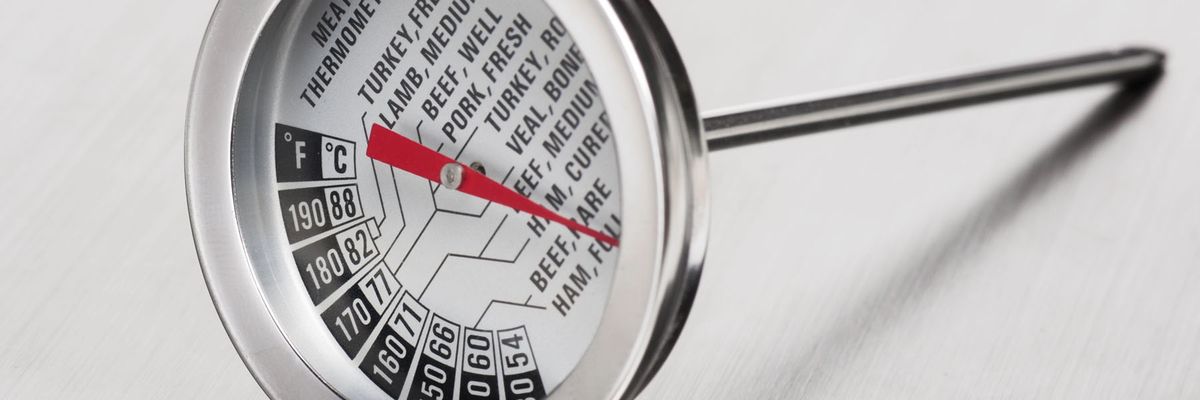
- Dial instant-reads. They take 15–20 seconds and need 2 inches of depth, so they can't read a burger or a chop. A digital one costs about the same.
- Meat claws and injectors, for now. Fun, not necessary. Get the thermometer habit down first.